Project brief
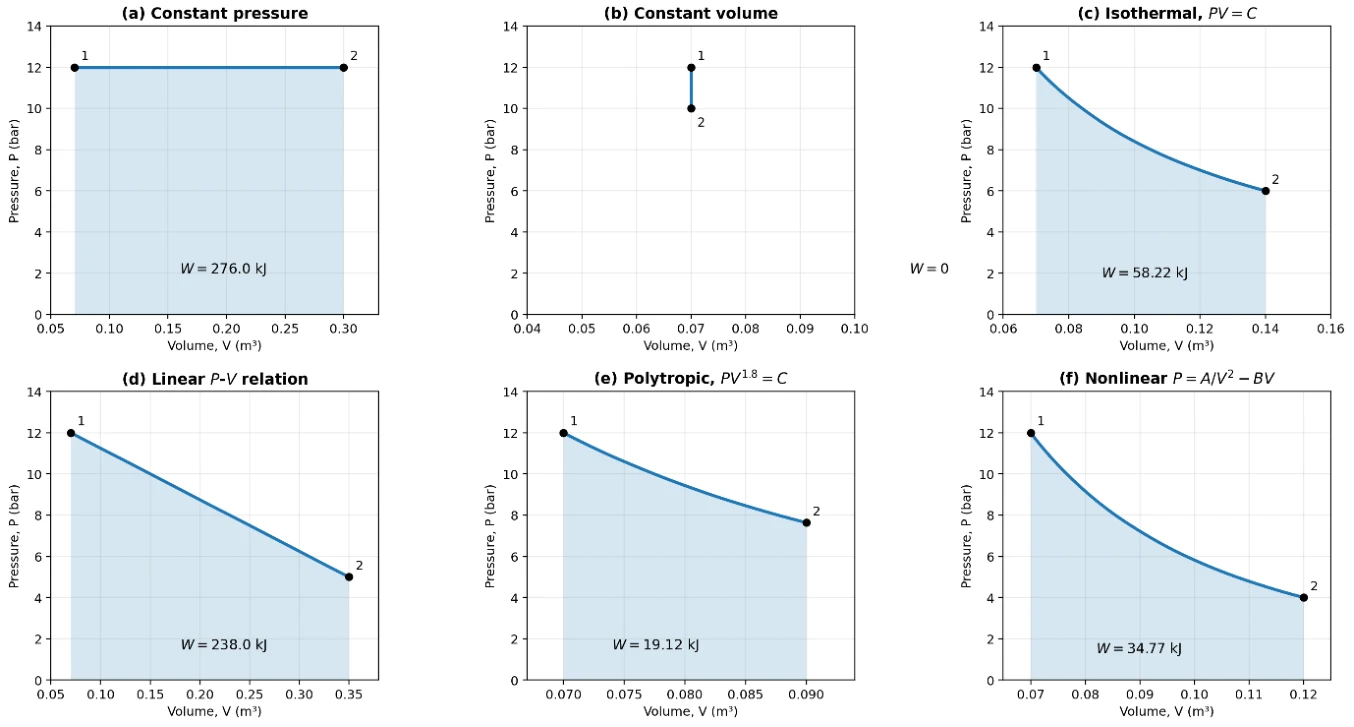
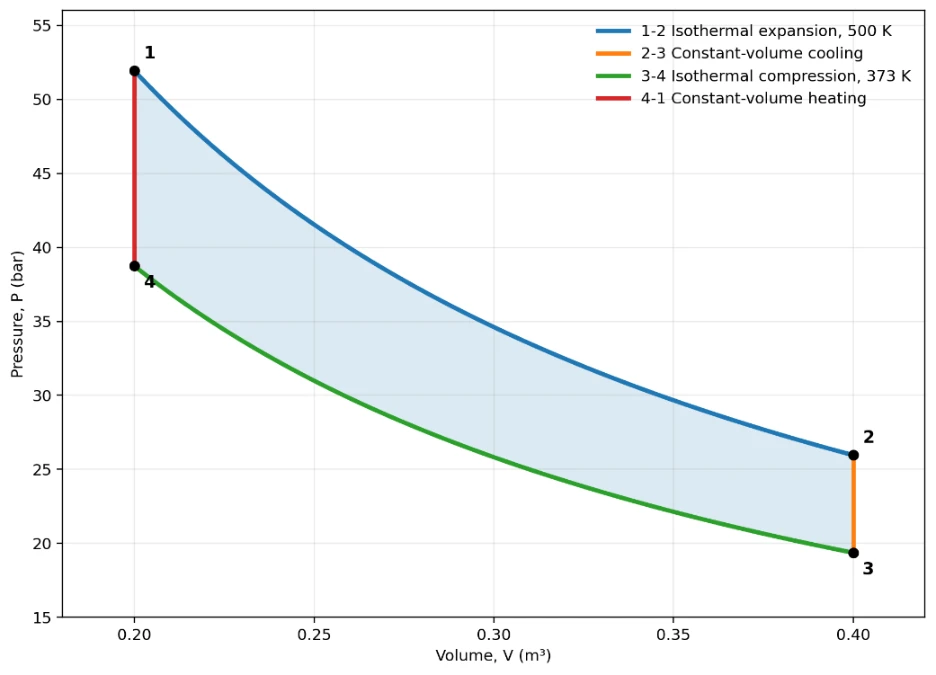
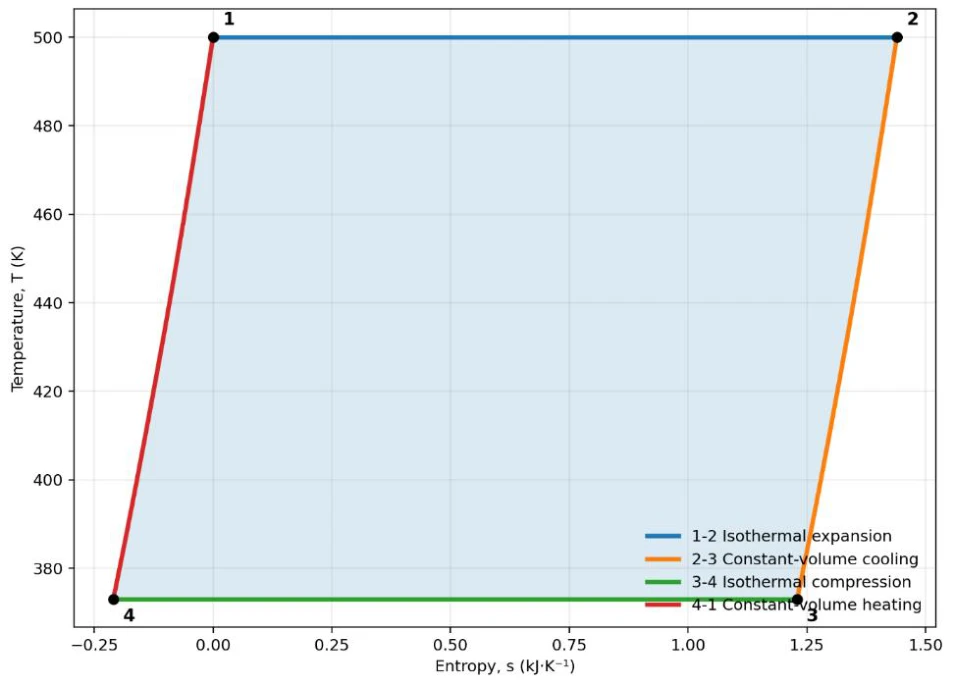
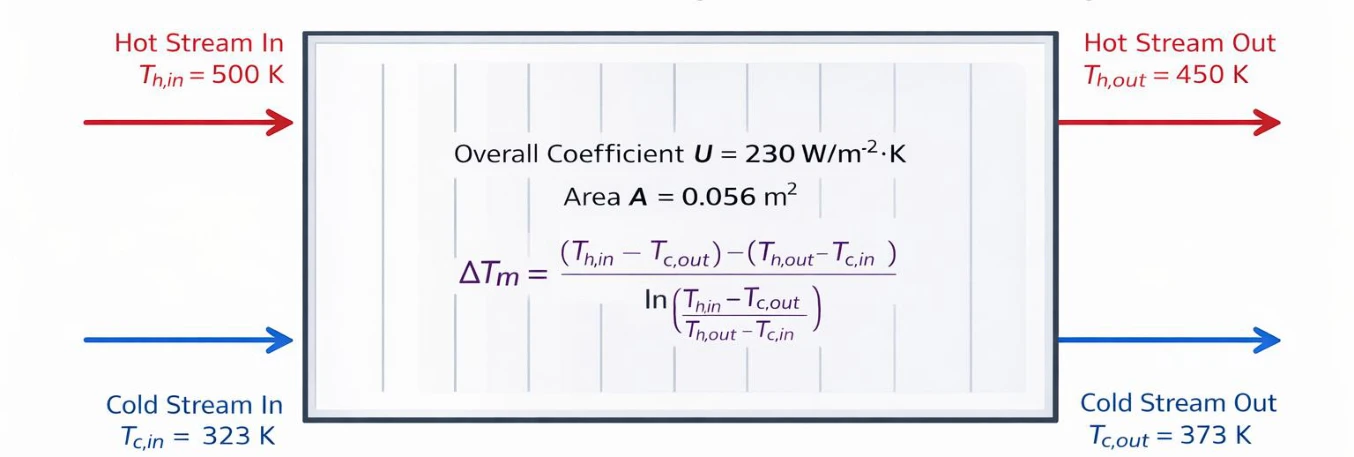
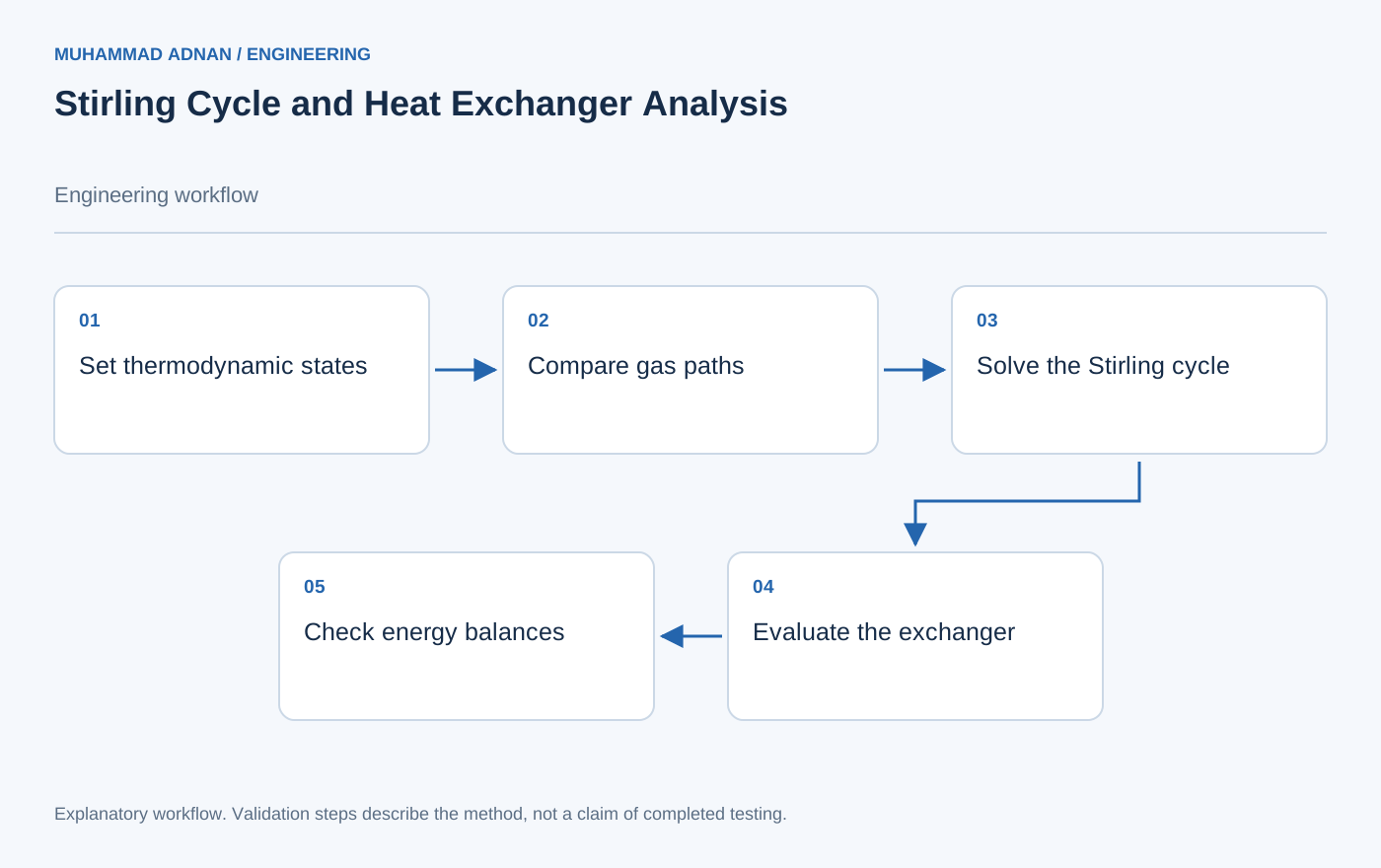
This thermodynamics study links an ideal closed-system Stirling cycle with an open-system parallel-flow heat exchanger. It first compares six gas processes from a common initial state, including constant pressure, constant volume, isothermal, linear, polytropic and nonlinear pressure-volume paths. Integrating each path reveals how the pressure history changes boundary work even when all cases begin at the same state. The Stirling calculation then evaluates four cycle states between 500 K and 373 K with a two-to-one volume ratio. Isothermal expansion and compression establish net work, while constant-volume heating and cooling describe the internally regenerated heat. A separate exchanger calculation uses the stated overall heat-transfer coefficient, area and stream temperatures to determine logarithmic mean temperature difference, thermal duty and effectiveness. First-law balances distinguish cycle energy from a continuous heat-transfer rate; the second-law discussion places ideal performance in context. The result is a connected analytical study of energy conversion and thermal recovery. All figures and numerical results represent the report's idealized dataset and assumptions, including perfect regeneration for the Stirling engine.
The engineering challenge
Keep work, regenerated heat and continuous exchanger duty consistent while comparing different thermodynamic processes.
Engineering approach
- Integrate six pressure-volume paths from the same initial state.
- Calculate ideal-gas state pressures and Stirling cycle heat and work.
- Apply perfect regeneration to identify external heat input.
- Use parallel-flow logarithmic mean temperature difference to calculate exchanger duty and effectiveness.
Results & observations
Ideal Stirling engine with perfect regeneration.
Ideal Stirling cycle between 500 K and 373 K.
Parallel-flow model with U=230 W/m²K and A=0.05617 m².
Calculated from the stated stream temperature changes.
Internal constant-volume heat recovery in the ideal cycle.
Features & capabilities
- Six gas-process comparisons
- Pressure-volume work integration
- Ideal Stirling state analysis
- Regenerative heat balance
- Parallel-flow exchanger calculation
- First- and second-law interpretation
Software & engineering tools
Ideal-gas equations, Pressure-volume integration, Energy balances, LMTD method