


Project brief
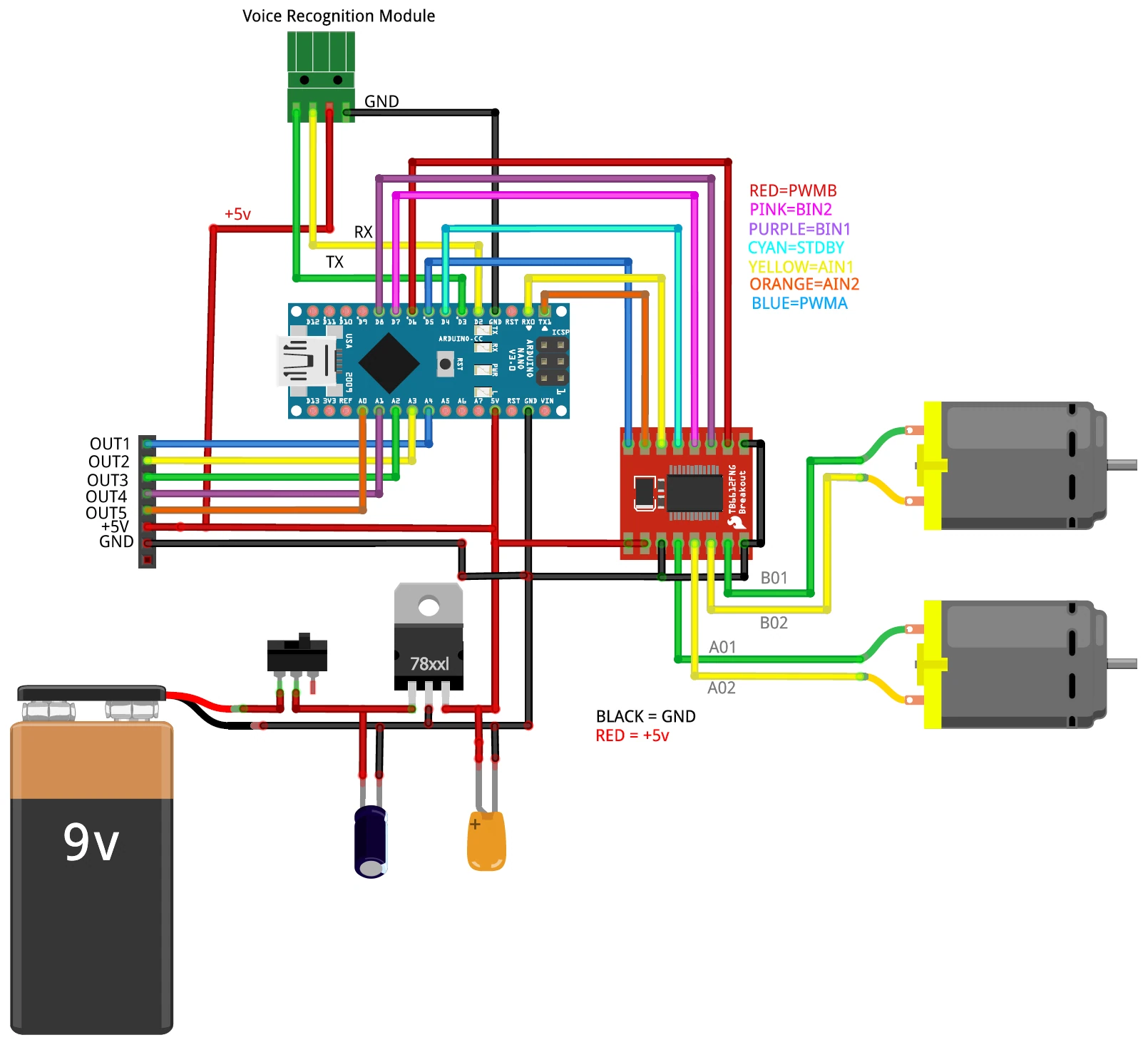
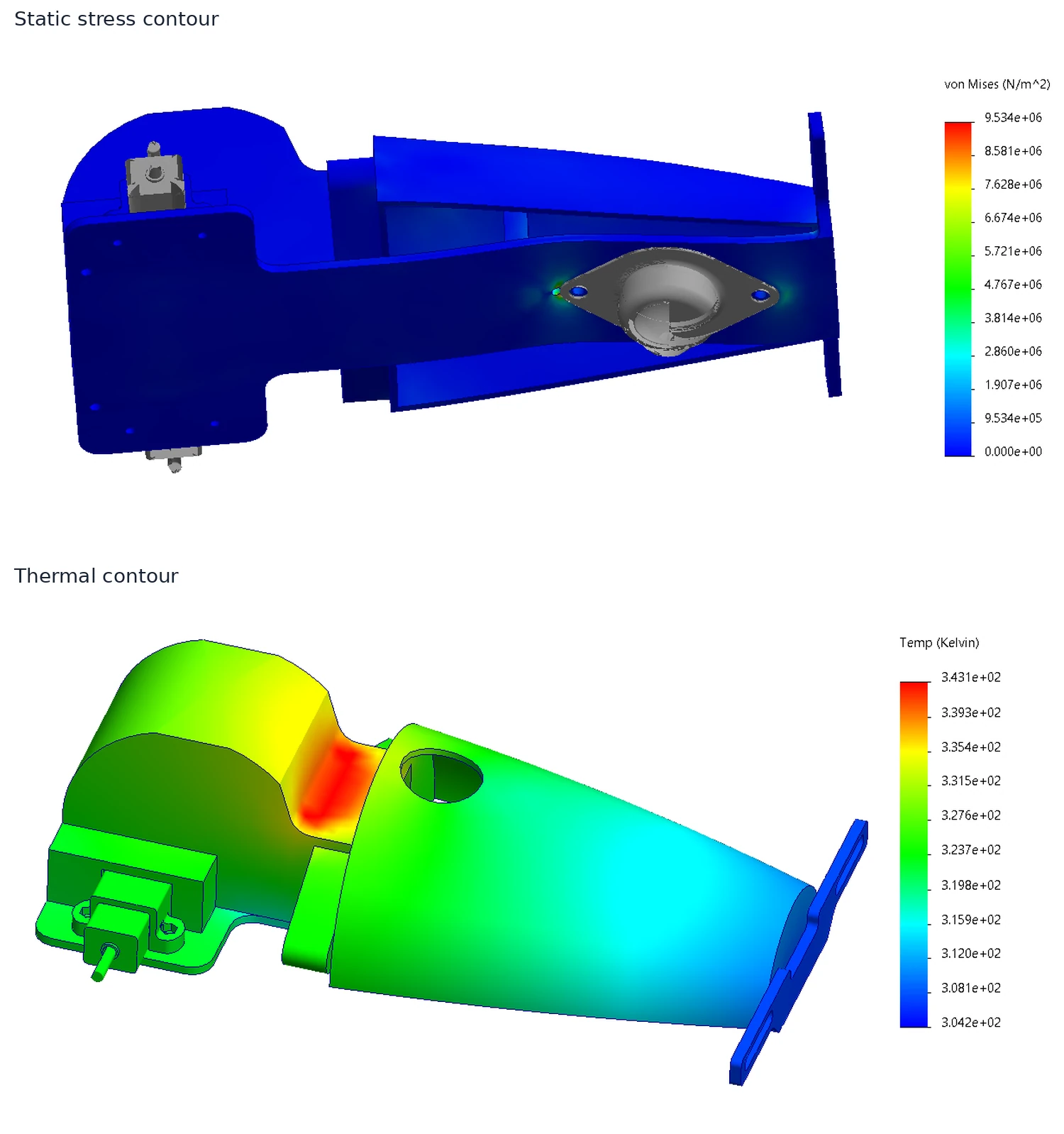
This project combines an Arduino Nano, a five-channel infrared line sensor, a voice-recognition module and a dual motor driver in a compact differential-drive robot. The supplied C++ appendix provides concrete implementation evidence: SoftwareSerial and VoiceRecognitionV3 handle the voice interface, five digital sensor reads provide line information, and a shared motor routine converts signed left and right speed commands into direction signals and PWM outputs. The main loop gives a recognized voice record priority for that iteration, dispatching forward, backward, left, right or stop commands. When no voice record is returned, explicit sensor conditions select forward movement, steering corrections or a stop. Mechanical development uses SolidWorks component models, a dimensioned assembly and an exploded component layout to arrange the motors, caster, sensor bar, battery, microphone and electronics. A wiring diagram and 55 × 33 mm PCB layout connect the controller, voice module, motor driver and regulated supply. The report also includes printed-part photographs and static and thermal simulation figures. Its narrative describes successful integration, but it supplies no quantified voice-recognition accuracy, track-completion rate or battery-runtime test. The code also returns to line-following logic when no new voice record arrives, so the displayed stop command is not a latched operating state. The project therefore demonstrates an implemented control structure and integrated hardware design with clear validation work still available.
The engineering challenge
Fit sensing, voice input, power regulation and two-motor control into a small printed chassis and express the interaction between manual commands and automatic line tracking in readable embedded code.
Engineering approach
- Model the base, shell, motor mounts and full assembly in SolidWorks, then document component placement and printed parts.
- Connect the Nano, TB6612FNG, infrared inputs and voice module through the supplied wiring and PCB design.
- Initialize the voice library and load five motion-command records.
- Translate signed motor-speed requests into H-bridge directions and PWM output in a reusable function.
- Dispatch recognized voice commands and apply the infrared decision tree as the fallback behavior; inspect static and thermal model outputs.
Results & observations
The supplied code loads forward, backward, left, right and stop records.
The appendix reads five analog-capable Nano pins as digital line-sensor inputs.
Reported board dimensions; the stated trace widths are 0.2 mm for data and 0.4 mm for power.
Reported CAD assembly dimensions, rather than a physical measurement survey.
Features & capabilities
- VoiceRecognitionV3 integration
- Five-sensor decision logic
- Reusable signed-speed motor control
- PWM differential drive
- SolidWorks assembly design
- Custom mixed through-hole/SMD PCB
Software & engineering tools
Arduino C++, Arduino IDE, SoftwareSerial, VoiceRecognitionV3, SolidWorks, SolidWorks Simulation